
|
| You might also like: | Charles Darwin | Fill in Missing Letters in Words Starting With Consonant Blends and Digraphs: CH - | Today's featured page: United Kingdom |
 Table of Contents |
Enchanted Learning ALL ABOUT BUTTERFLIES! |
Butterfly Calendar |
| What is a Butterfly? | Life Cycle | Butterfly Anatomy | Information Sheets | Glossary | Printables and Activities |
| Butterfly Glossary |
| A | B | C | D | E | F | G | H | I | J | K | L | M | N | O | P | Q | R | S | T | U | V | W | X-Z |
The peppered moth (Biston betularia) is a moth that was drastically affected by soot pollution in England in the 1800's and is a classic demonstration of natural selection.
In England in the 1880's, soot covered much of the landscape, following the advent of the Industrial Revolution. Previous to the soot problem, the light-colored variety of the moth (called typis) was common in England. Its speckled coloration helped camouflage the moth when perched on birch tree trunks (this nocturnal moth rests on birch tree trunks during the day). This type of camouflage is called cryptic coloration. After pollution covered many of the trees with a dark layer of soot and killed the light, whitish-gray colored lichens that lived on the tree trunks, a dark form of the moth (called carbonaria) was observed (presumably since the light-colored variety was no longer camouflaged when at rest on trees, and they were caught by birds - the dark-colored variety were now better camouflaged and more likely to survive and reproduce). The dark form of the peppered moth was first observed in 1848, and by 1895, 95 percent of the peppered moths were of the darker type. This phenomenon is called "industrial melanism."
| An Unpolluted Birch Forest | |
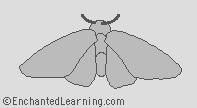 The light variety of the peppered moth on a birch tree trunk. |
 The dark variety of the peppered moth on a birch tree trunk. |
| A Polluted Birch Forest | |
 The light variety of the peppered moth on a soot-blackened tree trunk. |
 The dark variety of the peppered moth on a soot-blackened tree trunk. |
Recently, as cleaner-burning fuels have been used in England, the light-colored variety has returned to prominence.
For more on the peppered moth, click here for a page from Tulane University.
|
Butterfly Glossary |
|
|||||
| A | B | C | D | E | F | G | H | I | J | K | L | M | N | O | P | Q | R | S | T | U | V | W | X-Z |
Enchanted Learning®
Over 35,000 Web Pages
Sample Pages for Prospective Subscribers, or click below
|
Overview of Site What's New Enchanted Learning Home Monthly Activity Calendar Books to Print Site Index K-3 Crafts K-3 Themes Little Explorers Picture dictionary PreK/K Activities Rebus Rhymes Stories Writing Cloze Activities Essay Topics Newspaper Writing Activities Parts of Speech Fiction The Test of Time
|
Biology Animal Printouts Biology Label Printouts Biomes Birds Butterflies Dinosaurs Food Chain Human Anatomy Mammals Plants Rainforests Sharks Whales Physical Sciences: K-12 Astronomy The Earth Geology Hurricanes Landforms Oceans Tsunami Volcano |
Languages Dutch French German Italian Japanese (Romaji) Portuguese Spanish Swedish Geography/History Explorers Flags Geography Inventors US History Other Topics Art and Artists Calendars College Finder Crafts Graphic Organizers Label Me! Printouts Math Music Word Wheels |
Click to read our Privacy Policy
| Search the Enchanted Learning website for: |