



Red supergiant
Betelgeuse, a red supergiant in Orion.
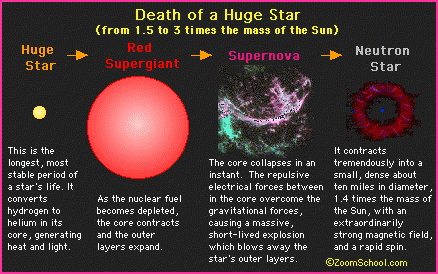
When huge stars grow old, they become even more enormous red supergiants (as their core fuses all the hydrogen into helium). Their core shrinks, becoming hotter and denser. With these changes, different nuclear processes occur; fusion now produces heavier elements (this temporarily stop the core’s shrinking).
Eventually this core collapses (in an instant). As the iron atoms are crushed together in this gravitational collapse, the core temperature rises to about 100 billion degrees.
Supernova
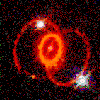
Supernova SN1987A:
the beginning of a supernova.
The repulsive electrical forces between the atoms’ nuclei overcomes the gravitational forces, causing a massive, bright, short-lived explosion called a supernova. During the explosion, shock waves, blow away the star’s outer layers.
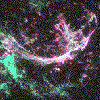
Supernova N132D: 3,000 years after a supernova, ejecting stellar material (including oxygen-rich gas) in luminescent shock fronts.
It is located in the Large Magellanic Cloud (169,000 light-years from Earth).
Neutron star / black hole
The next stage depends on the star’s remaining mass:
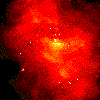
The Crab nebula: the remnant of a supernova
in A.D. 1054. It has a rapidly spinning neutron star.
- If the star’s remaining mass is between 1 1/2 to 3 times the mass of the Sun, it will collapse into a small, dense neutron star (about ten miles in diameter, about 1.4 times the mass of the Sun, with an extraordinarily strong magnetic field, and rapid spin).
- If the star’s remaining mass is greater than three times the mass of the Sun, the star contracts tremendously and becomes a black hole (incredibly dense with a gravitational field so strong that even light cannot escape).
Evolved star
An evolved star is an old star that is near the end of its existence. Its nuclear fuel is mostly gone. The star loses mass from its surface, producing a stellar wind (gas that is ejected from the surface of a star).