



The anemometer is a device that measures the speed of the wind (or other airflow, like in a wind tunnel). The first anemometer, a disc placed perpendicular to the wind, was invented in 1450 by the Italian architect Leon Battista Alberti. Robert Hooke, an English physicist, later reinvented the anemometer. In 1846, John Thomas Romney Robinson, an Irish physicist, invented the spinning-cup anemometer. In this device, cups are attached to a vertical shaft; when the cups spin in the wind, it causes a gear to turn.
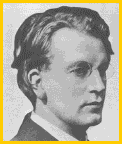
 John Logie Baird (1888-1946) was a Scottish inventor and engineer who was a pioneer in the development of mechanical television. In 1924, Baird televised objects in outline. In 1925, he televised human faces. In 1926, Baird was the first person to televise pictures of objects in motion. In 1930, Baird made the first public broadcast of a TV show, from his studio to the London Coliseum Cinema; the screen consisted of a 6-ft by 3-ft array of 2,100 tiny flashlamp bulbs. Baird developed a color television in 1928, and a stereo television in 1946. Baird’s mechanical television was usurped by electronic television, which he also worked on.

Alexander Graham Bell (March 3, 1847, Edinburgh, Scotland - August 2, 1922, Baddek, Nova Scotia) invented the telephone (with Thomas Watson) in 1876. Bell also improved Thomas Edison’s phonograph. Bell invented the multiple telegraph (1875), the hydroairplane, the photo-sensitive selenium cell (the photophone, a wireless phone, developed with Sumner Tainter), and new techniques for teaching the deaf to speak. In 1882, Bell and his father-in-law, Gardiner Hubbard, bought and re-organized the journal “Science.” Bell, Hubbard and others founded the National Geographic Society in 1888; Bell was the President of the National Geographic Society from 1898 to 1903.

Tim Berners-Lee (1955, London, England - ) invented the World Wide Web. His first version of the Web was a program named “Enquire,” short for “Enquire Within Upon Everything”. At the time, Berners-Lee was working at CERN, the European Particle Physics Laboratory located in Geneva, Switzerland. He invented the system as a way of sharing scientific data (and other information) around the world, using the Internet, a world-wide network of computers, and hypertext documents. He wrote the language HTML (HyperText Mark-up Language), the basic language for the Web, and devised URL’s (universal resource locators) to designate the location of each web page. HTTP (HyperText Transfer Protocol) was his set of rules for linking to pages on the Web. After he wrote the first browser in 1990, the World Wide Web was up and going. Its growth was (and still is) phenomenal, and has changed the world, making information more accessible than ever before in history. Berners-Lee is now a Principal Research Scientist at the Laboratory for Computer Science at the MIT (Massachusetts Institute of Technology, in Cambridge, Massachusett, USA) and the Director of the W3 Consortium.

The earliest bicycle was a wooden scooter-like contraption called a celerifere; it was invented about 1790 by Comte Mede de Sivrac of France. In 1816, Baron Karl von Drais de Sauerbrun, of Germany, invented a model with a steering bar attached to the front wheel, which he called a Draisienne. It has two wheels (of the same size), and the rider sat between the two wheels, but there were no pedals; to move, you had to propel the bicycle forward using your feet (a bit like a scooter). He exhibited his bicycle in Paris on April 6, 1818.
The first lawn mower was invented in 1830 by Edwin Beard Budding. Budding (1795-1846) was an engineer from Stroud, Gloucestershire, England. His reel mower was a set of blades set in a cylinder on two wheels. When you push the lawn mower, the cylinder rotates, and the blades cut the grass. Budding patented his lawn mower on August 31, 1830. Before his invention, a scythe was used (or sheep or other grazing animals were allowed to graze on the grass). The first reel lawn mower patent in the US (January 12, 1868) was granted to Amariah M. Hills, who formed the Archimedean Lawn Mower Co.

People have been drinking naturally-carbonated water (water with carbon dioxide bubbles) since pre-historic times. The English chemist Joseph Priestley experimented with putting gases in liquids in 1767, producing the first artificially-produced carbonated water.
In 1770, the Swedish chemist Torbern Bergman invented a device for making carbonated water from chalk and sulfuric acid.
The cat’s eye road reflector is a simple device that has saved countless lives. These inexpensive glass and rubber reflectors are set on the roadway at regular intervals, and help motorists see where the road is at night. Each of the cat’s eyes reflects oncoming light, acting like lights set into the road. This device was invented in 1933 by Percy Shaw, from Yorkshire, England. He invented it after he had been driving on a dark, winding road on a foggy night; he was saved from going off the side of the hill by a cat, whose eyes reflected his car’s lights. Shaw’s invention mimicked the reflectivity of a cat’s eyes. Because of his invention, Shaw was awarded the Order of the British Empire (“OBE”) by Queen Elizabeth of England in 1965.

William Caxton (1422?-1491) was an English businessman, royal advisor, translator, editor, and printer who set up England’s first printing press in 1476. Caxton had learned about printing in Cologne, Germany. In Brussels, he printed “The Recuyell,” the first book printed in the English language, around 1474. His second publication was “The Game and Play of Chess Moralised” (printed in 1476); this was the first printed book on chess and the first printed book to use woodcut illustrations. Caxton then returned to England and set up England’s first printing press (in 1476), where he printed ” Troilus and Creseide,” ” Morte d’Arthur,” ” The History of Reynart the Foxe,” Chaucer’s ” The Canterbury Tales,” and many other books. Since Caxton refused to print regional variations in English, he began the standardization of the English language and its spelling.

The crossword puzzle, a word game, was invented by Arthur Wynne in 1913. Arthur Wynne was a journalist born in Liverpool, England. Wynne wrote weekly puzzle for the US newspaper called the New York World. The first crossword puzzle by Wynne was a diamond-shaped puzzle that was published in the Sunday New York World on December 21, 1913. The first British crossword puzzle appeared on February 1922; it was published in Pearson’s Magazine.

Sir Humphry Davy (1778-1829) was an English scientist who invented the first electric light in 1800. He experimented with electricity and invented an electric battery. When he connected wires from his battery to two pieces of carbon, electricity arced between the carbon pieces, producing an intense, hot, and short-lived light. This is called an electric arc. Davy also invented a miner’s safety helmet and a process to desalinate sea water. Davy discovered the elements boron, sodium, aluminum (whose name he later changed to aluminium), and potassium.

Samuel Fox (1815 - 1887), an English inventor and manufacturer, invented the steel ribbed umbrella in 1852 (the ribs of the umbrella hold the fabric in place - wood or whale bone had been used as ribs before Fox’s invention). Fox started the “English Steels Company,” which manufactured his new umbrella.

A geologic time scale is a diagram that details the history of the Earth’s geology, noting major events like the formation of the Earth, the first life forms and mass extinctions. The first geologic time scale was proposed in 1913 by the British geologist Arthur Holmes (1890 - 1965). Holmes was also the first person to realize that the Earth was billions of years old (not millions, as had been previously believed).

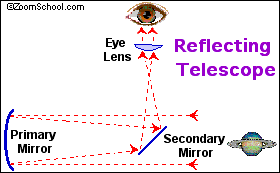 James Gregory (1638-1675), a Scottish mathematician, invented the first reflecting telescope in 1663. He published a description of the reflecting telescope in “Optica Promota,” which was published in 1663. He never actually made the telescope, which was to have used a parabolic and an ellipsoidal mirror.
John Hadley (1682-1744) was an English mathematician and inventor who built the first reflecting telescope and invented an improved quadrant in 1731 (known as Hadley’s quadrant). Hadley Rille, a long valley on the surface of the moon, was named for Hadley.
James Hargreaves (1720? - April 22, 1778) was an English weaver and spinner (he spun wool thread using a spinning wheel). He invented the spinning jenny, a hand-powered multiple spinning machine.
The spinning jenny was much more efficient than the spinning wheel. With a spinning wheel, a person could produce only one yarn thread at a time. With Hargreaves’ spinning jenny, a person could produce up to eight threads at once (it used one spinning wheel and 8 spindles on which threads were wound). The thread that the spinning jenny produced was coarse, and was only suited for filling material, but it was still quite a useful invention, and led the way to even better spinning devices.
Hargreaves is said to have gotten the idea for his remarkable invention after his young daughter (named Jenny) overturned his spinning wheel. When it was upturned, it continued to spin, and Hargreaves realized that many spinning wheels could be positioned like this, creating a multiple-wheeled spinning machine.
Hargreaves began selling spinning jenny’s from his home, near Blackburn, Lancashire, England. After hearing of his invention, local spinners became fearful of losing their jobs and broke into Hargreaves’ house, destroying his spinning jennies. He then moved to Nottingham, England (in 1768).
Thomas James became Hargreaves’ partner and they began a spinning mill which used spinning jennies (which could now produce even more threads per machine). Hargreaves patented the spinning jenny on July 12, 1770.
A geologic time scale is a diagram that details the history of the Earth’s geology, noting major events like the formation of the Earth, the first life forms and mass extinctions. The first geologic time scale was proposed in 1913 by the British geologist Arthur Holmes (1890 - 1965). Holmes was also the first person to realize that the Earth was billions of years old (not millions, as had been previously believed). For more information on geologic time scale, click here.
The first incandescent electric light was made in 1800 by Humphry Davy, an English scientist. He experimented with electricity and invented an electric battery. When he connected wires to his battery and a piece of carbon, the carbon glowed, producing light. This is called an electric arc.
Much later, in 1860, the English physicist Sir Joseph Wilson Swan (1828-1914) was determined to devise a practical, long-lasting electric light. He found that a carbon paper filament worked well, but burned up quickly. In 1878, he demonstrated his new electric lamps in Newcastle, England.
The inventor Thomas Alva Edison (in the USA) experimented with thousands of different filaments to find just the right materials to glow well and be long-lasting. In 1879, Edison discovered that a carbon filament in an oxygen-free bulb glowed but did not burn up for 40 hours. Edison eventually produced a bulb that could glow for over 1500 hours. The incandescent bulb revolutionized the world.
Lord Kelvin (William Thomson, 1824 - 1907) designed the Kelvin scale, in which 0 K is defined as absolute zero and the size of one degree is the same as the size of one degree Celsius. Water freezes at 273.16 K; water boils at 373.16 K.
For more information on Kelvin, click here.
Latex (a natural, stretchy substance from which rubber is made) is extracted from rubber trees. Rubber trees are large trees (belonging to the spurge family, family Euphorbiaceae) that live in tropical (warm) areas. These trees are tapped for their latex, which is produced in their bark layers (latex is not the sap). The Pará rubber tree (Hevea brasiliensis) is native to South American rain forests, and grows to be over 100 ft (30 m) tall. In 1876, Henry Wickham brought seeds from the Para rubber tree (taken from the lower Amazon area of Brazil) to London, England. Seedlings were grown in London, and later sent to Ceylon and Singapore. The technique of tapping rubber trees for their latex was developed in southeast Asia (before that, the trees were cut down to extract the rubber). Commercial rubber production now takes place in Malaysia, Thailand, Indonesia, and Sri Lanka (but not significantly in South America).
The first lawn mower was invented in 1830 by Edwin Beard Budding. Budding (1795-1846) was an engineer from Stroud, Gloucestershire, England. His reel mower was a set of blades set in a cylinder on two wheels. When you push the lawn mower, the cylinder rotates, and the blades cut the grass. Budding patented his lawn mower on August 31, 1830. Before his invention, a scythe was used (or sheep or other grazing animals were allowed to graze on the grass). The first reel lawn mower patent in the US (January 12, 1868) was granted to Amariah M. Hills, who formed the Archimedean Lawn Mower Co.

The “lead” pencil (which contains no lead) was invented in 1564 when a huge graphite (black carbon) mine was discovered in England. The pure graphite was sawn into sheets and then cut into square rods. The graphite rods were inserted into hand-carved wooden holders, forming pencils. They were called lead pencils by mistake — at the time, graphite was called black lead or “plumbago,” from the Greek word for lead (it looked and acted like lead, and it was not known at the time that graphite consisted of carbon and not lead).
In 1795, Nicolas-Jacques Conté (a French officer in Napoleon’s army) patented the modern method of kiln-firing powdered graphite with clay to make pencils of any desired hardness.

The first rubber band was made in 1845 by Stephen Perry of the rubber manufacturing company Messers Perry and Co., in London, England. This rubber band was made of vulcanized rubber. Perry invented the rubber band to hold papers or envelopes together.
Quoits is an outdoor game that is played by throwing an iron or steel quoit onto a peg-like metal pin sticking up out of soft clay. Quoits may have originally been a game in which a disc was thrown at a target, emphasizing accuracy (not distance), or it may have evolved from the game of horseshoes - its origin is unsure, but it certainly is an old game.

The first practical radar system was invented in 1935 by the Scotish physicist Sir Robert Alexander Watson-Watt (April 13, 1892-December 5, 1973). He developed radar to help track storms in order to keep aircraft safe. His invention eventually helped the allies win World War 2 against the Germans.
Radar is short for RAdio Detection And Ranging. Radar is used to locate distant objects by sending out radio waves and analyzing the echos that return. Radar can determine where a distant object is, how big it is, what shape it has, how fast it’s moving and in which direction it’s going. Radar is now used to watch developing weather patterns, to monitor air traffic, to track ships at sea, and to detect missiles.
The first lawn mower was invented in 1830 by Edwin Beard Budding. Budding (1795-1846) was an engineer from Stroud, Gloucestershire, England. His reel mower was a set of blades set in a cylinder on two wheels. When you push the lawn mower, the cylinder rotates, and the blades cut the grass. Budding patented his lawn mower on August 31, 1830. Before his invention, a scythe was used (or sheep or other grazing animals were allowed to graze on the grass). The first reel lawn mower patent in the US (January 12, 1868) was granted to Amariah M. Hills, who formed the Archimedean Lawn Mower Co.
A reflecting (or Newtonian) telescope uses two mirrors to magnify what is viewed. The reflecting telescope was first described by James Gregory in 1663.

The first method of refrigeration (cooling air by the evaporation of liquids in a vacuum) was invented in 1748 by William Cullen of the University of Glasgow, Scotland; Cullen did not apply his discovery to any practical purposes. Michael Farady, an English physicist liquefied ammonia to cause cooling (in the 1800’s). Faraday’s idea would eventually lead to the development of compressors, which compress gas to liquid form. The American inventor Oliver Evans designed the first refrigeration machine in 1805. In 1844, John Gorrie, an American doctor from Florida made a device based on Evans’ invention that would make ice in order to cool the air for yellow fever patients.
The first electric refrigerator was invented in 1803 by Thomas Moore. The first commercial refrigerator designed to keep food cold was sold in 1911 (by the General Electric Company) and in 1913 (invented by Fred W. Wolf of Fort Wayne, Indiana, USA); these model consisted of a unit that was mounted on top of an ice box. A self-contained refrigerator (with a compressor on the bottom of the cabinet) was invented by Alfred Mellowes in 1915. Mellowes produced this refrigerator commercially (each unit was hand made), but was bought out by W.C. Durant (the president of General Motors) in 1918, who started the Frigidaire Company in order to mass-produce refrigerators in the USA.
The first rubber band was made in 1845 by Stephen Perry of the rubber manufacturing company Messers Perry and Co., in London, England. This rubber band was made of vulcanized rubber. Perry invented the rubber band to hold papers or envelopes together.
Latex (a natural, stretchy substance from which rubber is made) is extracted from rubber trees. Rubber trees are large trees (belonging to the spurge family, family Euphorbiaceae) that live in tropical (warm) areas. These trees are tapped for their latex, which is produced in their bark layers (latex is not the sap). The Pará rubber tree (Hevea brasiliensis) is native to South American rain forests, and grows to be over 100 ft (30 m) tall. In 1876, Henry Wickham brought seeds from the Para rubber tree (taken from the lower Amazon area of Brazil) to London, England. Seedlings were grown in London, and later sent to Ceylon and Singapore. The technique of tapping rubber trees for their latex was developed in southeast Asia (before that, the trees were cut down to extract the rubber). Commercial rubber production now takes place in Malaysia, Thailand, Indonesia, and Sri Lanka (but not significantly in South America).

The sandwich was invented by John Montagu, the 4th Earl of Sandwich (1718-1792). About 1762, he is reputed to have been too busy to have a formal meal, and instructed his cook to pack his meat inside the bread to save him time - and the sandwich was invented.

The earliest known screwdriver dates from the 15th-century. Slotted screws (which were inserted with screwdrivers) were then used in knight’s armor. One is on display at the Metropolitan Museum of Art in New York City, New York.
The sextant is an astronomical instrument that is used to determine latitude for navigation. It does this by measuring angular distances, like the altitude of the sun, moon and stars. The sextant was invented independently in both England and America in 1731. The sextant replaced the astrolabe. The word sextant comes from the Latin word meaning “one sixth.”
The cat’s eye road reflector is a simple device that has saved countless lives. These inexpensive glass and rubber reflectors are set on the roadway at regular intervals, and help motorists see where the road is at night. Each of the cat’s eyes reflects oncoming light, acting like lights set into the road. This device was invented in 1933 by Percy Shaw, from Yorkshire, England. He invented it after he had been driving on a dark, winding road on a foggy night; he was saved from going off the side of the hill by a cat, whose eyes reflected his car’s lights. Shaw’s invention mimicked the reflectivity of a cat’s eyes. Because of his invention, Shaw was awarded the Order of the British Empire (“OBE”) by Queen Elizabeth of England in 1965.
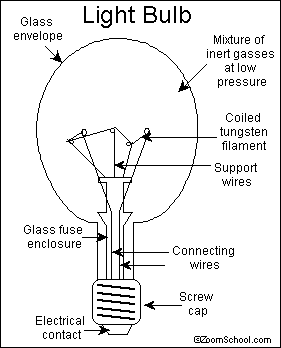 The first practical electric light bulb was made in 1878 simultaneously (and independently) by Joseph Wilson Swan and Thomas Alva Edison.
Sir Joseph Wilson Swan (1828-1914) was an English physicist who was determined to devise a practical, long-lasting electric light. After many years of experimentation, he found that a carbon paper filament worked well, but burned up quickly. In 1878, he demonstrated his new electric lamps in Newcastle, England.

The telephone (meaning “far sound”) is the most widely used telecommunications device. It was invented in 1876 by Alexander Graham Bell (with Thomas Watson). Bell patented his invention on March 1876 (patent No. 174,465). His device transmitted speech sounds over electric wires, and his idea has remained one of the most useful inventions ever made.

A telescope is a device that lets us view distant objects. Early telescopes (and most today) used glass lenses and/or mirrors to detect visible light. Some modern telescopes gather images from different parts of the electromagnetic spectrum, from radio waves to gamma rays. Most telescopes are located on Earth, but others are in space.
Joseph Gayetty invented toilet paper in 1857. His new toilet paper was composed of flat sheets. Before Gayetty’s invention, people tore pages out of mail order catalogs - before catalogs were common, leaves were used. Unfortunately, Gayetty’s invention failed. Walter Alcock (of Great Britain) later developed toilet paper on a roll ( instead of in flat sheets). Again, the invention failed.
In 1867, Thomas, Edward and Clarence Scott (brothers from Philadelphia, Pennsylvania, USA) were successful at marketing toilet paper that consisted of a small roll of perforated paper . They sold their new toilet paper from a push cart - this was the beginning of the Scott Paper Company.
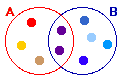
John Venn (1834 - 1923) was an English mathematician who invented the Venn diagram. His diagram clearly shows the similarities and differences for two different entities; it is a visual way to represent sets, and their unions and intersections.
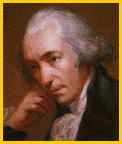
James Watt (1736-1819) was a Scottish inventor and engineer. In 1765, Watt revolutionized the steam engine, redesigning it so that it was much more efficient and four times as powerful as the old Newcomen steam engines. Watt’s engines did not waste steam (heat), and had a separate condenser. Watt partnered with the businessman and factory owner Matthew Boulton in 1772, helping to promote Watt’s ideas commercially. Watt also invented a method for converting the up-and-down piston movement into rotary motion (the “sun-and-planet” gear), allowing a greater number of applications for the engine. Watt produced this rotary-motion steam engine in 1781; it was used for many applications, including draining mines, powering looms in textile factories, powering bellows, paper mills, etc. It helped power the Industrial Revolution. Watt coined the term “horsepower,” which he used to convey the power of his engines; Watt calculated how many horses it would take to do the work of each engine. One horsepower equals 33,000 foot-pounds of work per minute; it is the power required to lift a total of 33,000 pounds one foot in one minute. Parliament granted Watt a patent on his steam engine in 1755, making Watt a very wealthy man. In 1882 (long after Watt’s death), the British Association named the unit of electrical power the “watt.”
Tim Berners-Lee (1955, London, England - ) invented the World Wide Web. His first version of the Web was a program named “Enquire,” short for “Enquire Within Upon Everything”. At the time, Berners-Lee was working at CERN, the European Particle Physics Laboratory located in Geneva, Switzerland. He invented the system as a way of sharing scientific data (and other information) around the world, using the Internet, a world-wide network of computers, and hypertext documents. He wrote the language HTML (HyperText Mark-up Language), the basic language for the Web, and devised URL’s (universal resource locators) to designate the location of each web page. HTTP (HyperText Transfer Protocol) was his set of rules for linking to pages on the Web. After he wrote the first browser in 1990, the World Wide Web was up and going. Its growth was (and still is) phenomenal, and has changed the world, making information more accessible than ever before in history. Berners-Lee is now a Principal Research Scientist at the Laboratory for Computer Science at the MIT (Massachusetts Institute of Technology, in Cambridge, Massachusett, USA) and the Director of the W3 Consortium.